Positive result

Both T and C lines appear. Target analyte captured.
SALIVA-BASED SCREENING PLATFORM
Decoding your mouth.
Oral Genome® is a validated point-of-care screening platform designed to detect active biological signals associated with oral and systemic health — delivering real-time insights to support preventive and longitudinal care models.
For wellness and screening purposes only. Not intended to diagnose, treat, cure, or prevent any disease.
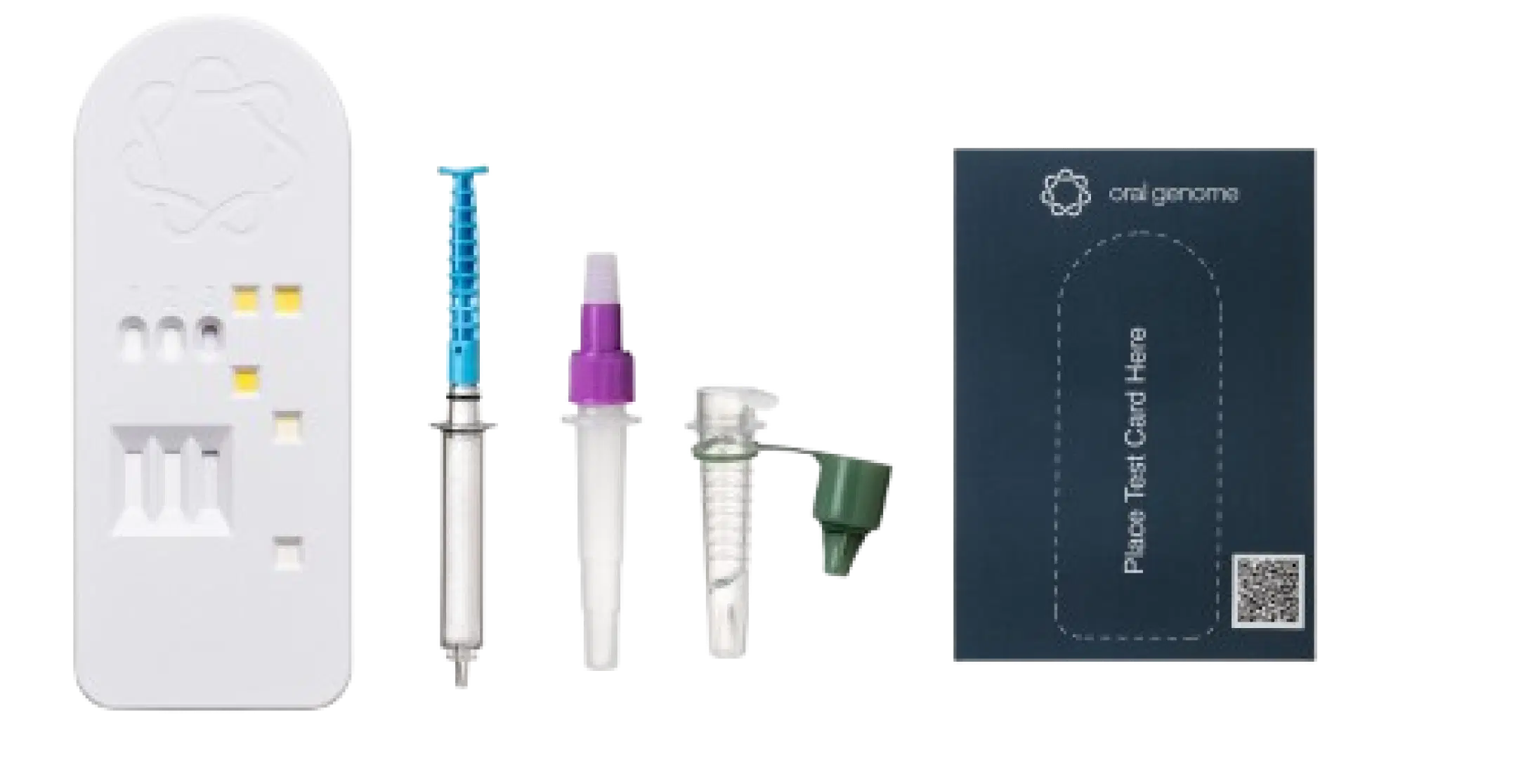
Validation Overview
Oral Genome has undergone rigorous validation spanning laboratory performance, manufacturing consistency, clinical sample evaluation, and environmental stability — demonstrating reliable results across real-world conditions.
R² >0.95
Calibration curves met predefined acceptance criteria with low variability across replicates and stable signal detection.
10K+
Tens of thousands of test strips evaluated across production runs from start to end of batch — all met quality specifications.
Real-world
Evaluated using real human saliva samples with consistent signal detection and reproducible results across replicates.
Stable
Performance maintained under elevated temperature stress and extended storage. Validated across clinical, home, and community settings.
Platform Technology
A multi-analyte platform combining lateral flow immunoassay and colorimetric pad chemistry — detecting host-response markers, pathogens, and oral environment signals from a single saliva sample at the point of care.
Lateral flow captures MMP-8 and P. gingivalis via antibody-based gold nanoparticle conjugates. Colorimetric pads simultaneously measure pH, buffering capacity, nitric oxide, and proteins.
Unlike DNA-based sequencing, Oral Genome detects active protein expression and live bacterial loads — distinguishing an active biological event from historical genetic residue.
Results generated chairside in real time — no lab send-out, no days-long turnaround. Designed for integration into routine dental workflows without specialized equipment.
Computer vision reads both lateral flow bands and colorimetric pad intensities in a single image — eliminating subjective visual reading and logging results automatically.
Ongoing refinements across software, hardware, and manufacturing informed by real-world deployment data to improve performance and usability.
Science Behind The Test
Oral Genome combines two proven test formats in one. Lateral flow immunoassay detects MMP-8 and P. gingivalis. A colorimetric dipstick strip — like a UTI test but for saliva — measures pH, buffering capacity, nitric oxide, and proteins. Saliva is dropped directly onto each test zone; the Oral Genome app reads both simultaneously.
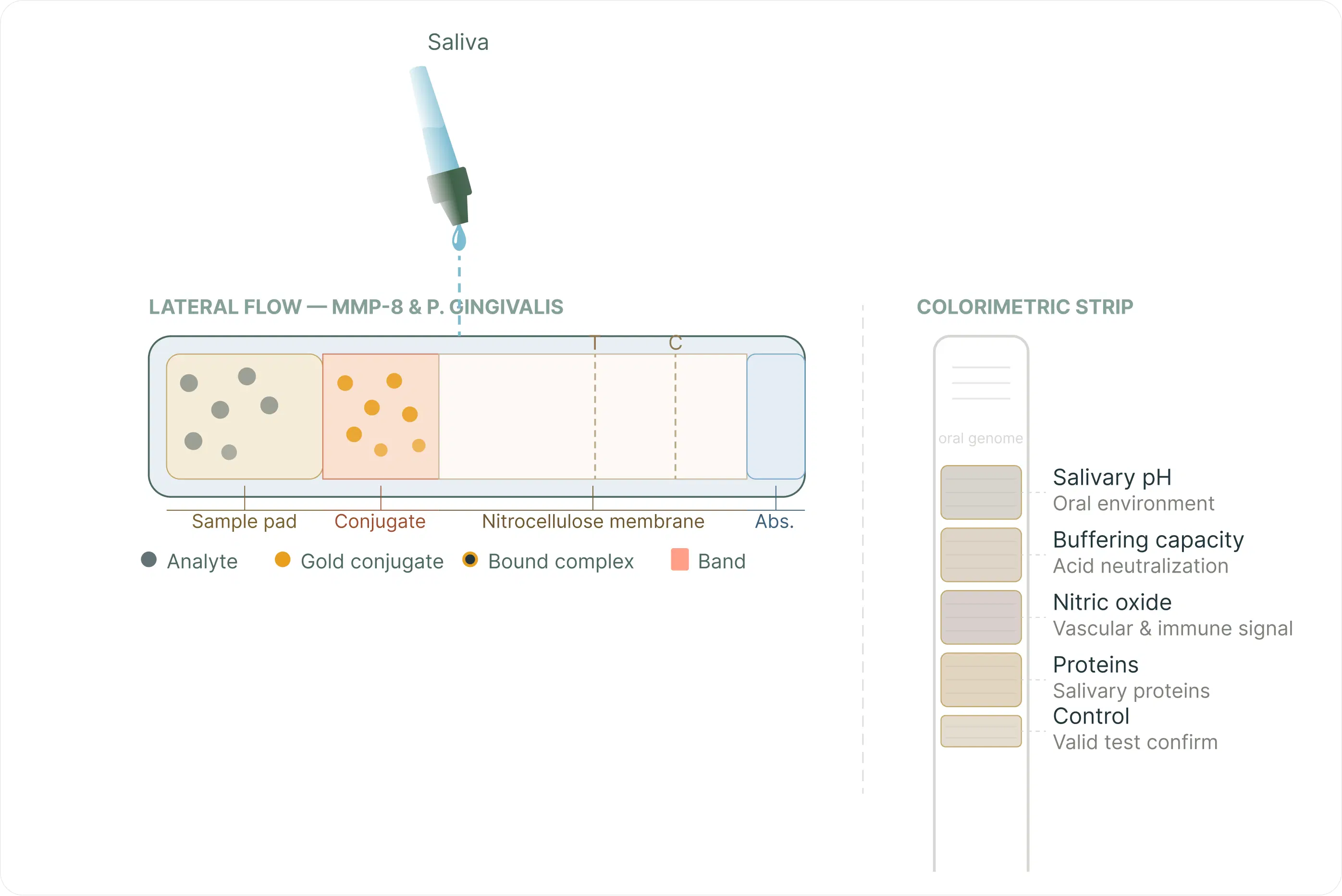
Step 1 — Saliva dropped directly onto both test zones
Using a dropper, saliva is applied directly onto the sample pad of the lateral flow cassette (left) and onto the colorimetric pads of the dipstick strip (right). No dipping, no cup. The dropper delivers a controlled volume to each test zone.
Lateral flow result interpretation
Positive result
Both T and C lines appear. Target analyte captured.
Negative result

Only C line appears. No analyte captured at T.
Invalid result
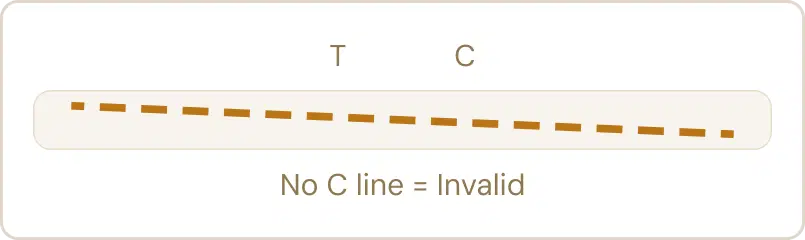
Control line absent. Flow or reagents failed.
Competitive context
How Oral Genome compares
Saliva testing has evolved - but most approaches still rely on either DNA sequencing or quantitative PCR (qPCR) methods that weren't designed for point-of-care use. Oral Genome takes a fundamentally different approach.
DNA sequencing platforms
Microbiome-based mail-in testing
Days-to-weeks turnaround - no real-time clinical decision support
Detects DNA presence only - not active biological activity or live load
Requires laboratory infrastructure - not chairside
Cannot detect host inflammatory response
Results require specialist interpretation
Oral Genome
Lateral flow + colorimetric point-of-care platform
Real-time results at chairside - no lab send-out required
Detects active protein signals and live bacterial activity
6 markers: MMP-8, P. gingivalis, pH, buffering, nitric oxide, proteins
AI + computer vision - standardized across operators
Designed for longitudinal preventive care monitoring
qPCR-based tests
Quantitative PCR laboratory methods
Requires thermocycler equipment and trained personnel
Amplifies DNA only - cannot detect host inflammatory markers
Higher cost and longer processing limits routine screening
Prone to contamination artifacts - strict QC required
Not designed for high-volume preventive screening workflows
Analytical specificity
Selective detection of intended targets
Oral Genome assays demonstrated no measurable cross-reactivity with common oral bacteria, real-world substances, or complex salivary proteins under tested conditions.
MMP-8 assay
Host-response marker
Evaluated against five oral bacterial species at 10⁶ CFU/mL:
No cross-reactivity observed
P. gingivalis assay
Pathogen-specific marker
Evaluated following sample preparation optimization:
Selective detection confirmed
Interference testing
Real-world conditions - no interference observed
Tested in the presence of common oral substances and salivary proteins in both positive and negative samples:

Alcohol
No effect

Toothpaste
No effect

Mouthwash
No effect

OTC meds
No effect

IgA
No effect

Transferrin
No effect

Amylase
No effect